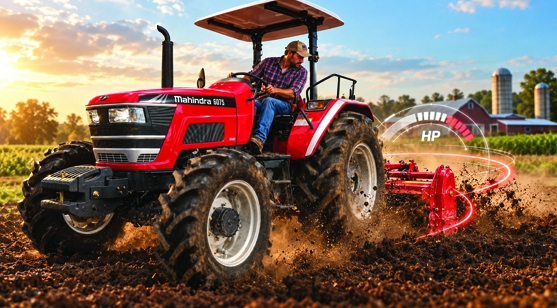
How to Choose the Right Tractor Horsepower for Every Farm Size
01 September 2026
Choosing the right tractor is one of the most important decisions a farmer can make. While features and technology matter, horsepower (HP) plays a critical role in determining a tractor's performance, efficiency, and operating costs. Selecting a tractor with too little power can limit productivity, while investing in more horsepower than you need may increase purchase and fuel costs unnecessarily.
The key is to find the right balance based on your farm size, soil conditions, crop requirements, and the implements you plan to use.
Start with Your Farm Size
Farm size provides a useful starting point when selecting tractor horsepower.
Up to 5 Acres: 15-35 HP
For small farms, orchards, vineyards, and horticulture applications, tractors in the 15-35 HP range are often sufficient. These compact and versatile machines can efficiently handle cultivation, spraying, sowing, inter-cultivation, and light transportation tasks. Their smaller size also makes them ideal for working in confined spaces and narrow field rows.
5 to 15 Acres: 36-50 HP
Medium-sized farms typically benefit from tractors in the 36-50 HP category. These tractors offer an excellent balance of power, versatility, and fuel efficiency. They can comfortably manage routine tillage, planting, spraying, haulage, and a wide range of farm implements, making them suitable for diversified farming operations.
Above 15 Acres: 50 HP and Above
As farm size increases, so does the demand for higher productivity and faster field operations. Tractors with 50 HP and above are well-suited for larger farms where heavy implements, challenging soil conditions, and extended operating hours are common. Higher horsepower enables farmers to cover more ground in less time while maintaining operational efficiency.
Farm Size Isn't the Only Factor
While acreage is important, it should not be the sole basis for selecting tractor horsepower.
Two farms of similar size can have completely different power requirements. Heavy clay soils demand greater pulling power than light sandy soils. Likewise, farms using larger rotavators, cultivators, seed drills, or ploughs typically require more horsepower than those focused on spraying or light transport applications.
Consider Implement and PTO Requirements
Modern tractors do more than pull implements; they also power equipment through the Power Take-Off (PTO) system. Equipment such as rotavators, seed drills, balers, sprayers, and threshers have specific power requirements to operate effectively.
Before purchasing a tractor, always verify the recommended horsepower requirements for the implements you currently use or plan to add in the future. Matching tractor power to implement requirements helps maximize performance and fuel efficiency.
Plan for Future Growth
A tractor is a long-term investment, often serving a farm for many years. Therefore, it is important to consider not only your current needs but also your future plans.
If you anticipate expanding your farm acreage, adopting new cropping patterns, or investing in larger implements, choosing a tractor with additional horsepower today can help avoid a costly upgrade later.
Find the Right Balance
The best tractor is not necessarily the one with the highest horsepower rating. Instead, it is the one that aligns with your farm's size, workload, soil conditions, implements, and budget.
By carefully evaluating these factors, farmers can select a tractor that delivers optimum performance, fuel economy, and long-term value.
Get the Right Power with Mahindra Farm Equipment
At Mahindra Farm Equipment, we offer a comprehensive range of tractors designed to meet the diverse needs of modern farming. From compact tractors for small holdings to high-horsepower machines for large-scale operations, our portfolio ensures there is a solution for every farm.
Talk to our experts today to find the tractor that matches your land, applications, and future growth plans, helping you achieve greater productivity and profitability season after season.